| MOQ: | 1 Ton |
| Price: | USD 1150-1500 per MT |
| Standard Packaging: | 25 kg laminated woven bag with moisture barrier liner, 1000 kg jumbo bag, or bulk liner bag as required |
| Delivery Period: | 3 days for each 25 tons |
| Payment Method: | T/T |
| Supply Capacity: | 30000 tons per year |
Aluminium fluoride is a widely used active agent in glass surface treatment. In frosting and etching paste formulations it supplies the fluoride ion that attacks the silicate network of the glass, producing the satin, matte surface used on lampshades, cosmetic bottles, decorative panels and mirror borders. This powder grade is milled to a fine mesh and screened so that it disperses quickly into acid or paste carriers and reacts evenly across the glass surface, which is the difference between a uniform matte finish and patchy streaks.
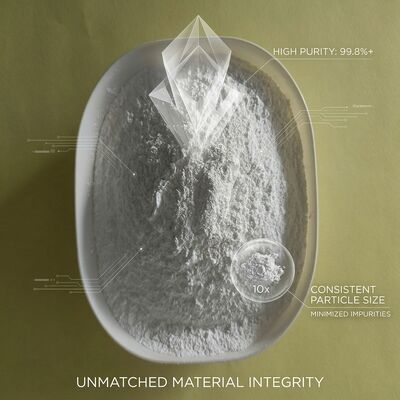
The product is synthesised from high purity raw materials, dried and milled in a closed circuit. A controlled fine particle size raises reactive surface area, so formulators can shorten the dwell time of the etching paste or reduce the quantity of active fluoride required for the same degree of frosting.
Key Features| Parameter | Specification |
|---|---|
| Product Name | Aluminium Fluoride Powder (AlF3) |
| CAS Number | 7784-18-1 |
| Chemical Formula | AlF3 |
| Molar Mass | 83.98 g/mol |
| Assay (AlF3 content) | 99 percent minimum |
| Appearance | White powder, crystalline |
| Mesh Size | 200 mesh, 325 mesh and 2000 mesh cuts |
| Moisture Content | 0.3 percent maximum |
| Loss on Ignition | 1.0 percent maximum at 550 C |
| Silica Content | 0.15 percent maximum |
| Iron Oxide Content | 0.03 percent maximum |
| Sulfate Content | 0.10 percent maximum |
| Crystal Structure | Cubic |
| Solubility | Soluble in hydrofluoric acid and hydrochloric acid |
| Flammability | Non flammable |
Glass frosting and etching is the leading application for this powder grade. Manufacturers mix aluminium fluoride into a paste with water, ammonium bifluoride or acid, screen print or dip the article, and wash off the residue to obtain a silk matte surface. Lamp bulb interiors, wine and cosmetic bottles, mirror frames and architectural glass panels are all finished this way. Because the powder dissolves quickly, the paste holds its strength through a full production shift.
The same fine powder serves ceramic and enamel production, where it acts as an opacifier and flux in glaze formulations and helps the glaze mature at a lower firing temperature. It is also used in the synthesis of fluoroaluminate chemicals, in aluminium surface preparation before plating, and as a flux component in metal joining operations where oxide films must be broken down at low temperature. Formulators value the combination of fine mesh, high assay and predictable behaviour in both aqueous and solvent based systems.
Packaging & Quality AssuranceThe powder is packed in 25 kg laminated woven bags with an inner polyethylene moisture barrier, in 1000 kg jumbo bags, or in customised packages for paste producers that require pre weighed batch sizes. Storage in a dry, closed warehouse keeps the mesh cut and moisture content stable for at least one year.
Each production lot is sampled after milling and tested for assay, mesh distribution, moisture, loss on ignition, silica, iron oxide and sulfate; the certificate of analysis accompanies every shipment. Orders from one tonne are dispatched within three days, and plant capacity of 30,000 tonnes per year supports long term supply contracts. Contact our technical team for sample quantities, mesh selection advice and OEM labelling.